

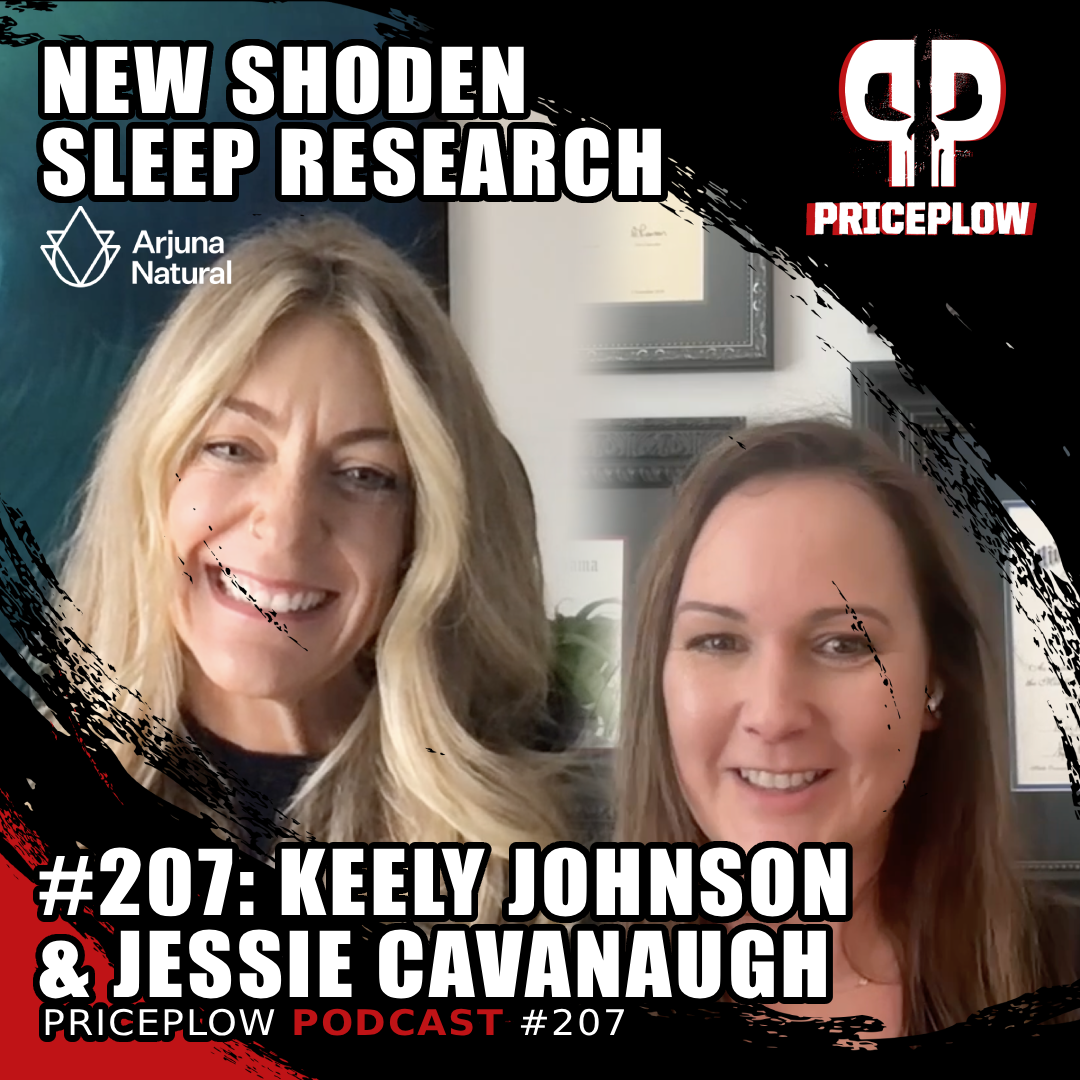
Jessie Cavanaugh of Nutraceuticals Research Institute and Keely Johnson of Arjuna Natural break down the science of cortisol awakening response, ashwagandha research methodology, and Shoden’s groundbreaking three-arm study on Episode #207 of the PricePlow Podcast.
Episode #207 of the PricePlow Podcast brings together Keely Johnson, VP of Sales and Marketing at Arjuna Natural, and Dr. Jessie Cavanaugh of Nutraceuticals Research Institute for a deep dive into cortisol science and ashwagandha research methodology. Jessie, a Harvard Medical School Clinical Scholars Training Program alumna, just completed what she describes as the first botanical study ever to use timestamped cortisol awakening response (CAR) measurements. The subject: Shoden ashwagandha at 60mg, in a three-arm trial with Shoden, Shoden-R, and placebo.
Also joining for her podcast debut is Victoria Johnson, registered nurse and familiar face from the PricePlow Instagram channel, who brings a hands-on clinical angle to the conversation.
The episode covers what separates quality nutraceutical research from noise, why cortisol balance matters far more than cortisol suppression, and where Shoden is headed: into beverages, pre-workouts, and potentially women’s multivitamins. If you caught Keely on Episode #171 covering the Shoden revolution, this is the scientific sequel.
Before diving in, subscribe to the PricePlow Podcast on your favorite platform and sign up for Arjuna Natural news alerts on PricePlow so you’ll know the moment the CAR study publishes.
0:00 – Introductions
Mike opens by welcoming two returning elements and one first: Keely Johnson of Arjuna Natural (back from Episode #171), Jessie Cavanaugh of Nutraceuticals Research Institute in her podcast debut, and Victoria Johnson making her first PricePlow Podcast appearance. Victoria introduces herself as a registered nurse with nearly nine years of clinical experience and a strong interest in lifting and supplementation.
Keely reintroduces Arjuna Natural’s focus on Indian botanicals and branded ingredients, noting that the team brought Nutraceuticals Research Institute on specifically for new Shoden research. Mike flags that cortisol awakening response will be the central thread and sets up Jesse to take the floor.
1:45 – Jessie Cavanaugh’s Background
Jessie’s PhD dissertation was a clinical trial studying pre-procedural stress in children on the autism spectrum, and she’s spent over 20 years in the natural products industry as both educator and researcher. After completing her doctorate, she went through Harvard Medical School’s Clinical Scholars Training Program, which deepened her focus on methodology within the nutraceutical space. She now runs Nutraceuticals Research Institute, where the sole focus is conducting high-quality, methodologically sound studies for natural products.
Her throughline: 20 to 30 years ago, the problem was too little research on natural products. Today there’s more research, but not necessarily good research. That’s the gap her lab targets.
3:00 – What Makes Good Nutraceutical Research
Jessie identifies two major methodological problems in nutraceutical research. First, many studies are designed by people who weren’t trained in clinical research, producing results that can’t distinguish signal from noise and often fail to account for demographic variables like socioeconomic background or sex differences. Second, researchers frequently borrow outcome tools from the pharmaceutical industry (tools built to measure sick people getting well) which creates ceiling effects when studying generally healthy populations taking nutraceuticals.
Her fix: purpose-built psychometric tools, proper outcome endpoints, and controlling for the population rather than hoping the demographics even out. She almost always runs male and female participants separately because “those differences are just too big.”
5:30 – Recruiting the Right Study Population

When studying something like Shoden for stress, you want people who are actually stressed — not individuals who’ve already optimized their routines with breathwork, supplements, and five years of stress-management habits. Jessie’s team screens heavily to find the right chronic-stress population, then uses advanced statistics to control remaining variables rather than relying on simple t-tests.
She also flags a nuance that often gets overlooked: exclusion criteria matter as much as inclusion criteria. Someone going through a divorce, for example, introduces too much unpredictable external noise. The goal is isolating that low-lying chronic stress that blunts the cortisol awakening response — not acute life disruptions that would swamp any intervention signal.
7:00 – Acute vs. Chronic Stress
There are two flavors of stress: acute (state) and chronic (trait). Pre-procedural stress (the spike you feel before a blood draw, a test, or a surgical procedure) is acute and can actually be healthy, building resilience when it doesn’t go too high. Chronic stress is the low-grade constant load of modern life, the kind that keeps cortisol elevated overnight and blunts the morning surge you need to start the day.
Jessie’s studies on Shoden target that chronic category, identifying participants whose cortisol hasn’t come down enough overnight and whose awakening response is consequently blunted. She notes that acute stress is harder to evaluate precisely because the “right” level depends heavily on the individual and context.
11:15 – Cortisol: Beyond “The Stress Hormone”

Shoden brings a new era to ashwagandha supplements with 35% glycowithanolide standardization. Research shows it delivers powerful effects at just 60-120mg daily, compared to 600mg+ with traditional extracts.
Cortisol gets a bad reputation, but Keely offers a personal data point: about ten years ago she tested her own levels through the Dutch test (the only test she’s aware of that measures cortisol at multiple points across a 24-hour period) and found hers were undetectable. That experience reshaped how she thinks about balance versus suppression. The goal isn’t to eliminate cortisol, it’s to have the right amount at the right times.
Jessie reinforces the physiology: cortisol levels drop low during sleep while the body runs its overnight maintenance, then begin rising just before waking in concert with the lightening sky. Again, the issue isn’t having cortisol, it’s having cortisol in its correct rhythm throughout the day.
13:45 – The Cortisol Awakening Response
In the first 30 minutes after waking, a healthy cortisol awakening response (CAR) produces a 50 to 80% spike from baseline. That surge is what activates cognitive function, clears brain fog, and gets the body ready to navigate the day. It’s connected to immune function, energy regulation, and even metabolic markers like type 2 diabetes risk. People with chronic stress often see a blunted CAR — some participants in the study were only hitting a 20% rise at baseline.
That’s why measuring cortisol at a fixed clock time across all participants is nearly useless. You don’t know if you’re catching the peak, the plateau, or the decline. Jessie’s protocol has participants keep a saliva vial at the bedside and collect a sample before sitting up, then set a 30-minute alarm for the second sample — no coffee, no breakfast, no toothbrushing in between. That dynamic captures the actual CAR.
18:00 – Study Protocol & Lifestyle Controls

Not all ashwagandha extracts are created equal. This guide explains why standardization matters, why extract ratios can be misleading, and how to identify quality products when shopping for this popular adaptogen.
Caffeine definitively interacts with cortisol production, so participants in Jessie’s studies can’t have coffee until after both saliva samples are collected. Beyond that, the rule is simple: don’t change anything. If a participant was doing yoga or meditation before the study, they keep doing it. If they weren’t, they don’t start. Any lifestyle change introduces noise that could swamp the Shoden signal.
The same logic applies to cell phones and blue light. Rather than asking participants to stop “doom-scrolling” before bed (which would itself alter cortisol) the study accepts real-world habits and focuses on isolating the ingredient’s effect. Victoria notes that misinformation around cortisol (particularly in women’s wellness circles on social media) makes this kind of clean methodology even more valuable.
20:00 – The Three-Arm Shoden Study
The study (which hasn’t yet published as of this recording in February 2026) enrolled women aged 30 to 59 and used three arms: Shoden-R, Shoden root and leaf, and placebo. The dose was 60mg, which Keely notes is the lowest on the market. The primary outcome was the cortisol awakening response. Results showed no significant difference between Shoden-R and Shoden, while both outperformed placebo, meaning the water-soluble beverage-stable form delivers the same benefit as the original capsule form.
Keely flags this as the first botanical study in the world to use properly timestamped CAR measurement. Rather than targeting a specific cortisol number, the study was designed to bring the CAR into range — whether a participant was too blunted or slightly too elevated, the intervention moved them toward that 50 to 80% Goldilocks zone.
23:30 – Decentralized Studies & Participant Compliance
Jessie draws a clear line between a decentralized study (click-to-consent, package mailed to your door, surveys filled out via app) and an in-person study. The Shoden CAR study was in-person, but she’s conducted both types. The problem with fully decentralized studies is participant authenticity — put an Amazon gift card behind an app survey and you’ll attract people gaming the system rather than following protocol.

Arjuna Natural’s Shoden-R ashwagandha just won Ingredient Idol at SupplySide Global 2025. The root-only extract is water-soluble, works at 60mg, and finally makes ashwagandha viable in beverages, gummies, and RTD formats.
Her solution for any study is relationship-based compliance. From the informed consent session onward, participants are treated as collaborators, not subjects. They understand exactly why the protocol matters and sometimes self-organize to keep each other accountable. The result: participants contact the lab proactively when they miss a dose timing or deviate slightly from protocol — which is precisely the kind of data integrity that allows clean conclusions.
27:15 – Study Outcomes & the Blunted Cortisol Surge
In addition to the cortisol biomarker, the study used psychometric tools to assess perceived stress and captured secondary and tertiary outcomes including sleep quality — a natural downstream effect when CAR improves. Victoria asks whether subjective questionnaires were included alongside the saliva samples, and Jessie confirms they were, noting that psychometrics often pick up real-world effects that a single biomarker can miss.
On the blunted surge question: it typically happens because cortisol never fully dropped overnight. Already-elevated baseline levels don’t have far to rise, leading to wonky patterns throughout the day — undetectable troughs or unexpected spikes. The goal is that clean steep upturn in the morning followed by a gradual descent, which is exactly what Shoden appears to support.
31:00 – Formulating with Shoden: Beyond Calm

Keely is direct: not all ashwagandhas are created equal, and Shoden isn’t just a calming ingredient. A pharmacokinetic (PK) study comparing top market brands found Shoden still present in the body at up to 20 hours — longer than competitors — supporting the idea of sustained cortisol balance rather than acute suppression. She takes it before workouts herself and describes the effect simply: “I’m a better human.” Not tired, not sedated — just more able to let stress roll off and focus.
Mike adds the testosterone angle: ashwagandha’s documented support for testosterone levels likely runs at least partially through cortisol reduction, since chronic stress actively suppresses the body’s ability to produce testosterone. That makes a case for Shoden in daily pre-workouts, not just in sleep and recovery formulas.
34:00 – Shoden-R in Functional Beverages
Shoden-R is the water-soluble version of Shoden, with bitterness, taste, and smell removed, making it fully functional in beverages at just 60mg. Arjuna Natural’s sparkling water demo at SupplySide Global 2025 won the Ingredient Idol competition for functional beverages, with judges commenting on how clean and easy-to-drink it was. More recently, Shoden-R appeared at Expo West 2026 in sparkling water, strawberry peach drinks, and orange mango chews.
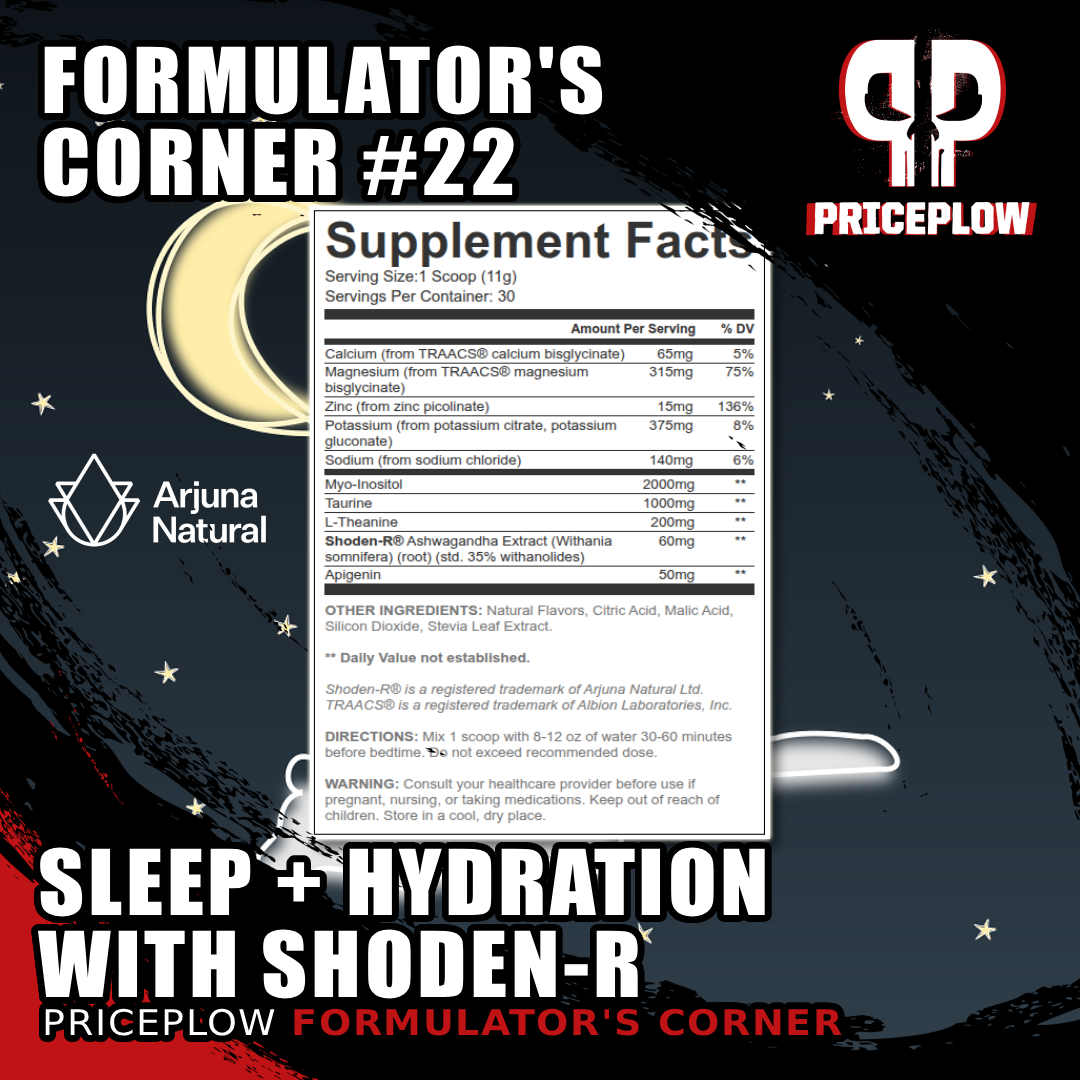
What if one evening formula could tackle stress, sleep, AND hydration? Formulator’s Corner #22 designs a nighttime recovery powder with Shoden-R ashwagandha, glycine minerals, and smart osmolytes. Will a brand bring it to market?
No commercial beverages with Shoden-R have launched yet, but Keely says formulators are actively working with it and reporting that it’s easy to use and easy to flavor at the low dose. Victoria raises the question of caffeinated beverages — Keely confirms someone is already exploring it in an iced tea — and the consensus is that the beverage category is wide open, from grab-and-go RTDs at Whole Foods to convenience store shelves.
37:00 – Cortisol Balance, Testosterone & Consistency
The bigger-picture message from Jessie: Shoden works best as a preventive, modulatory daily habit, not an acute stress-response tool. Taking it only when you feel overwhelmed means you’re always playing catch-up. Taking it consistently keeps the cortisol rhythm stable, which in turn supports cognition, testosterone production, immune function, and workout quality. That’s the throughline — and it connects to why Formulator’s Corner #22 built an entire nighttime hydration and sleep formula around Shoden-R.
Mike points out that many in the gym community already take a pre-workout every day, workout or not, and Shoden fits the same usage pattern naturally. Getting it into that daily ritual — whether in a pre-workout, a multivitamin, or a beverage — is where the long-term benefit compounds.
40:30 – Sleep Hygiene, Shift Work & Daily Habits
Jessie’s most underrated sleep hygiene tip: keep your sleep timing consistent day after day. The body runs on rhythms, and consistent bed and wake times do more for cortisol regulation than most of the noisier advice circulating on social media. She acknowledges this isn’t always accessible — Victoria, as a nurse, has experienced shift work firsthand — but it’s the simplest, most overlooked variable.

Bennito Russo, Keely Johnson, and Nipen Lavingia from Arjuna Natural’s team reveals the science behind Shoden ashwagandha’s superior bioavailability and their industry-leading botanical standardization on the PricePlow Podcast #171.
For shift workers, Keely’s recommendation is to focus on consistency of supplement timing across the entire week, regardless of which days are on or off. The adrenaline response in a demanding clinical environment will happen regardless, but supporting the body biochemically on a daily schedule gives the adrenal system a better foundation.
44:30 – What’s Next: Menopause Research, Publication & The Book
The Shoden CAR study is heading into peer review and Jessie expects it to publish very soon — she’s the lead author. The next study is already written: a menopause-focused trial, women-only again, studying a more concentrated age group than the 30 to 59 range covered in the current work. Keely has a long list of research questions she wants to tackle, including the relationship between cortisol and inflammation and how Shoden affects post-workout recovery.
Jessie also has a book coming out in summer 2026: The Female Stress Response, covering everything discussed in this episode — sleep hygiene, ashwagandha, and practical strategies for cortisol regulation. She’s most active on LinkedIn. Mike closes out by teasing a potential product giveaway through PricePlow and BevLab, with Keely offering to send Shoden-R beverages and chews to the community.
This was a genuinely different kind of episode. Jessie’s methodological rigor cuts right through a lot of the noise in ashwagandha research, and the cortisol awakening response framework gives us a much sharper lens for understanding what Shoden actually does in the body. Watch for the study publication, and sign up for Arjuna Natural alerts on PricePlow to catch it the moment it drops.
Thanks to Perfect Shaker for sponsoring this episode. You can check out their incredible shaker cups at PerfectShaker.com — and Keely was spotted drinking out of one on camera, so the endorsement is clearly real.
Subscribe to the PricePlow Podcast on any platform, sign up for Arjuna Natural news on PricePlow, and leave us a great review on iTunes and Spotify!




Add comment