
Hi friends! If you’ve been thinking about starting strength training but have no idea where to begin – this one’s for youuuuuu.
Maybe you’ve been mostly a cardio girl (hi, same), or maybe you took a long break and want to get back to it without injuring yourself in week one. Either way, I’ve got you. As an Integrative Health Practitioner and Women’s Fitness Specialist, strength training is one of the things I recommend most consistently to the women I work with – especially once we hit our 30s and 40s. The research and the real-life results both back it up.
This guide walks you through everything: why strength training matters so much after 35, what to expect, how to progress safely, and a full 4-week plan to get you started. Let’s goooo.
If you want to cut to the chase and download the plan, here you go! Strength plan for women over 35

In This Post
- Why Strength Training Is So Important After 35
- Before You Start: What You Actually Need
- How to Progress (The Simple System)
- Your 4-Week Beginner Strength Training Plan
- The Workout Moves: Upper, Lower, and Total Body
- Tips for Beginners That Nobody Tells You
- When You’re Ready to Level Up
- At-Home Option I Love
- FAQ
Why Strength Training Matters After 35
After 35, our bodies start doing things we didn’t sign up for. Energy shifts, recovery takes longer, and it gets harder to maintain muscle without actively working for it. A lot of this comes down to hormonal changes (like declining estrogen and progesterone) and sarcopenia: the natural loss of muscle mass that starts in our mid-30s and accelerates if we don’t do anything about it.
Here’s the thing though: strength training directly counters this. I see it over and over with my clients: women who start lifting weights in their 30s and 40s feel completely different. They have more energy, better sleep, stronger bones, improved insulin sensitivity, and a body composition that cardio alone just can’t touch.
A few reasons strength training is non-negotiable at this life stage:
Bone density. Our bones peak in our 20s and then gradually decline. Resistance training stimulates bone-forming cells and helps slow – and even reverse – bone loss, which matters a lot as we head toward perimenopause and beyond.
Muscle preservation. After 35, we can lose 3–8% of our muscle mass per decade without consistent resistance training. Muscle is metabolically active – more of it means a higher resting metabolism, which helps with everything from body composition to energy levels.
Hormones and blood sugar. Strength training improves insulin sensitivity and helps regulate blood sugar for hours after your workout. For women navigating hormone changes, this is huge.
Mental health. The research on strength training and mood is genuinely impressive – multiple large studies have linked regular resistance training to significant reductions in anxiety and depressive symptoms.
The takeaway: cardio is great and I love a good walk, but strength training is the non-negotiable piece that most women are missing.
Before You Start: What You Actually Need
You do not need a ton of equipment or a gym membership to start — especially at the beginning.
Equipment Essentials
The basics:
Nice to have as you progress:
- A second set of slightly heavier dumbbells (10–15 lbs)
- Resistance bands
- Adjustable dumbbells – worth the investment long-term
A Note on Shoes
Please invest in a good pair of cross-training shoes. Running shoes actually aren’t ideal for lifting because the cushioning can throw off your balance during squats and deadlifts. A flat-soled shoe or a cross-trainer gives you much better ground contact. These are the ones I recommend.
Consider Working With a Trainer First
Even one or two sessions with a certified personal trainer to go over form can be a total gamechanger. Form matters so much more than how much weight you’re lifting, especially with moves like deadlifts and rows where incorrect mechanics can lead to injury. Even a virtual session can help you get your movement patterns down before you start adding load.
How to Progress: The Simple System
Here’s the approach I use and recommend: simple, sustainable, and way less overwhelming than trying to decode all the fitness industry jargon.
Phase 1: Bodyweight First
Before you pick up a single dumbbell, start with bodyweight versions of the movements. This teaches your body the patterns, builds the mind-muscle connection, and honestly still gets you sore. Don’t skip this step.
Phase 2: Add Light Weight
Once bodyweight feels comfortable, grab the lightest dumbbells and work with those. Seriously, lighter than you think. Everyone is sore their first week no matter what, and you want to be able to move the next day.
The Rep and Set Progression
Start here: 2 sets of 12 reps per exercise
When that feels easy: Increase to 3 sets of 12 reps
From there: Increase the weight slightly and work back up to 3 sets of 10–12 reps — this is the hypertrophy range where you’ll start seeing real muscle definition
That’s it. Simple, progressive, and super effective. The goal is progressive overload, which is gradually asking your muscles to do a little more over time, and this system does exactly that without overcomplicating things.
Download the plan here: strength plan for women over 35
Your 4-Week Beginner Strength Training Plan
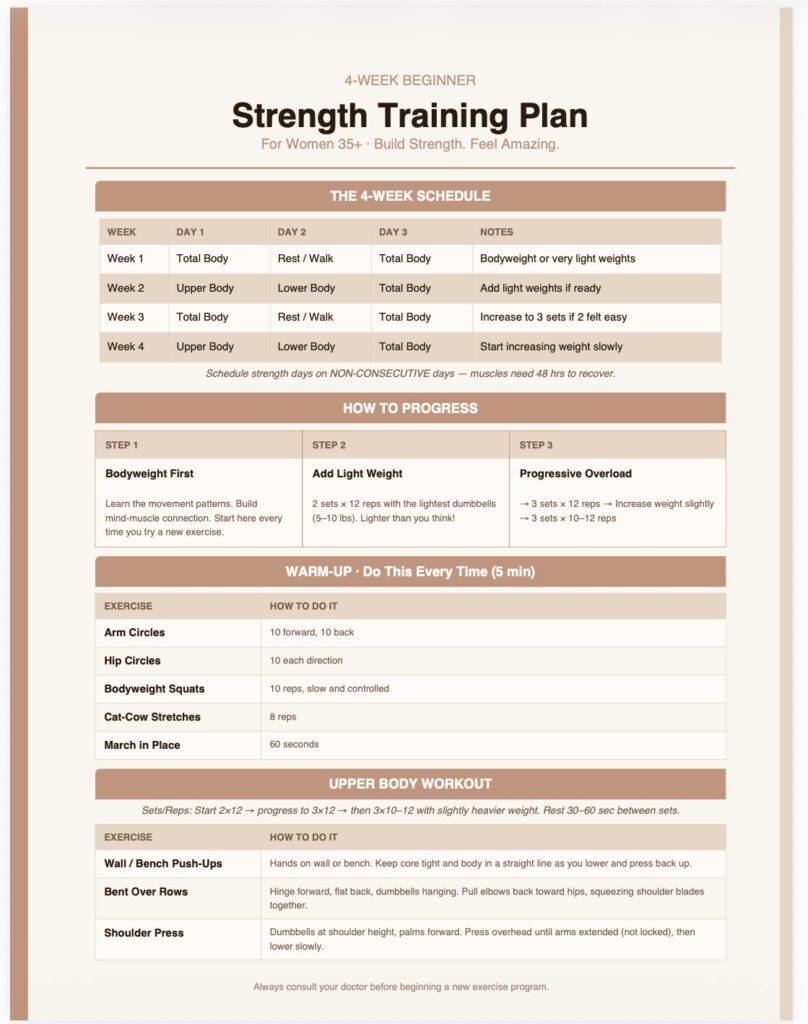
Weeks 1 and 3 are the same (two total-body days), and weeks 2 and 4 are the same (three days with an upper/lower/total-body split). This gives your body time to adapt before you add a third session.
Important: Always schedule your strength days on non-consecutive days. Your muscles need 48 hours to recover between sessions – that’s actually when the magic happens. Think Monday/Thursday, or Tuesday/Saturday.
| Week | Day 1 | Day 2 | Day 3 | Notes |
|---|---|---|---|---|
| Week 1 | Total Body | Rest or Walk | Total Body | Bodyweight or very light weights |
| Week 2 | Upper Body | Lower Body | Total Body | Add light weights if ready |
| Week 3 | Total Body | Rest or Walk | Total Body | Increase to 3 sets if 2 felt easy |
| Week 4 | Upper Body | Lower Body | Total Body | Start increasing weight slowly |
Rest days: These aren’t lazy days, this is well-deserved and giving your body a chance to recover and refresh. Walking, stretching, or gentle yoga on your off days is perfect.
The Workout Moves
Warm-Up (Do This Every Time – 5ish Minutes)
Don’t skip this. A good warm-up prepares your joints and reduces injury risk significantly.
- Arm circles — 10 forward, 10 back
- Hip circles — 10 each direction
- Bodyweight squats, slow and controlled – 10 reps
- Cat-cow stretches – 8 reps
- March in place or light jog – 60 seconds
Upper Body Workout
Sets/Reps: Start with 2 sets of 12. Progress to 3 sets of 12, then 3 sets of 10–12 with slightly heavier weight. Rest 30–60 seconds between sets.
| Exercise | How To |
|---|---|
| Wall or Bench Push-Ups | Start at the wall or with hands on a bench. Keep your core tight and body in a straight line as you lower and press back up. |
| Bent Over Rows | Hinge forward from your hips with a flat back, dumbbells hanging. Pull elbows back toward your hips, squeezing your shoulder blades together. |
| Shoulder Press | Stand or sit with dumbbells at shoulder height, palms forward. Press overhead until arms are extended (not locked), then lower slowly. |
| Tricep Dips | Hands on the edge of a sturdy chair, feet flat on the floor. Lower your body by bending your elbows, then press back up. |
| Bicep Curls | Stand tall, dumbbells at your sides, palms facing forward. Curl up to shoulder height and lower with control — no swinging! |
Lower Body Workout
Sets/Reps: Same progression — 2 sets of 12 → 3 sets of 12 → 3 sets of 10–12 with more weight.
| Exercise | How To |
|---|---|
| Bench Squats | Stand in front of a chair or bench, feet hip-width apart. Lower until you lightly touch the seat, then stand back up. This teaches the squat pattern safely. |
| Stationary Lunges | Stand tall, step one foot forward. Lower your back knee toward the floor, keeping your front knee behind your toes. Do all reps on one side, then switch. |
| Bench Hip Raises | Sit on the floor with your upper back against a bench, feet flat. Drive through your heels to lift your hips until your body is in a straight line. Squeeze at the top! |
| Sumo Squats | Take a wide stance with toes pointed out. Hold one dumbbell at your center or two at your sides. Squat low, keeping your chest tall. |
| Romanian Deadlifts | Hold dumbbells in front of your thighs. Hinge at the hips — push them back as the weights lower along your legs. Feel the hamstring stretch, then stand back up tall. |
Total Body Workout
Sets/Reps: Same progression system.
| Exercise | How To |
|---|---|
| Squat to Press | Hold dumbbells at shoulder height. Squat down, then as you stand, press the weights overhead. Lower them back to shoulders as you squat again. Great bang for your buck! |
| Bent Over Row | Hinge forward, flat back, pull elbows back toward hips. Same as upper body day. |
| Upright Row | Stand tall, dumbbells together in front of you. Pull them straight up toward your chin, leading with your elbows. Lower slowly. |
| Walking Lunges | Step forward into a lunge, bring your back foot to meet the front, then lunge on the other side. Add dumbbells when bodyweight feels easy. |
| Sumo Deadlift | Wide stance, toes out, weights between your feet. Push the floor away as you stand up — squeeze your glutes at the top. Lower with control. |
Tips for Beginners That Nobody Tells You
You will be sore. That’s not bad, it’s just the beginning. DOMS (delayed onset muscle soreness) typically hits 24–48 hours after your first few sessions. Gentle movement, protein, water, and a little patience will get you through it, and it gets better over time.
Lighter weights are not a cop-out. Starting light lets you nail your form, which is what protects you from injury and actually makes you stronger long-term. The weight will go up, I promise.
Tracking makes everything easier. Even jotting down what you did in your notes app helps you see progress and know when it’s time to increase. You’ll forget what you lifted two weeks ago – write it down.
Protein matters. Your muscles need amino acids to repair and grow after training. If you’re not getting enough protein, you’re leaving results on the table. I aim for around 30g per meal for my clients.
Recovery is part of the plan. Sleep, hydration, and rest days aren’t optional extras – they’re where your body actually gets stronger. Honor your non-training days.
When You’re Ready to Level Up
Once three days a week feels totally manageable and you’ve been consistent for a few weeks, you might want to add a fourth day. Here’s how that looks:
4-Day Split Option:
- Day 1: Upper Body
- Day 2: Lower Body
- Day 3: Rest
- Day 4: Upper Body
- Day 5: Lower Body
- Days 6–7: Rest
At this point you can also explore a push/pull split — push days (chest, shoulders, triceps) and pull days (back, biceps) with lower body days mixed in. But honestly? If you’re training four days consistently and progressively adding weight? You’ve made it. You are no longer a beginner — and that is something to be genuinely proud of.
At-Home Option I Love: The Sculpt Society
If you want guided workouts you can do at home, especially on days when going to the gym feels like too much, I’m a huge fan of The Sculpt Society. Megan Roup’s programming is excellent for women, the workouts are fun, and there are options for every level including true beginners. It’s a great complement to this plan on your active recovery days, or if you just want a little more variety in your routine.
FAQ
Is it safe to start strength training if I’ve never lifted before?
Yes, and it’s actually one of the safest forms of exercise when you start with appropriate weight and proper form. Beginning with bodyweight and working with a trainer for even one session can make the process feel much less intimidating.
How soon will I see results?
You’ll likely feel stronger within two weeks. Visible muscle tone typically shows up around 4–6 weeks with consistent training. Progress photos and how your clothes fit are often more telling than the scale.
Will I get bulky from lifting weights?
This is one of the most common fears and it’s really not how it works for most women. We don’t have the testosterone levels needed to build bulk without very deliberate, years-long effort. What most women experience is leaner, more defined muscles and a stronger-looking physique.
How many days a week should a beginner strength train?
Start with two days per week. Once that feels sustainable, move to three. Most women thrive at three strength sessions per week. It’s enough to see real results without burning out or overtaxing your recovery.
What if I’m sore – should I still work out?
Light soreness is normal and gentle movement actually helps. But if you’re very sore – like struggling with stairs – give yourself an extra rest day. Pushing through severe soreness often leads to injury, not faster results.
Do I need to do cardio too?
You don’t need to add a lot of cardio to see great results from strength training, especially at the beginning. Daily walking is wonderful and supports hormone balance. Beyond that, add cardio based on what you enjoy.
What should I eat before and after strength training?
Before: something with a mix of carbs and protein 1–2 hours before if possible like a banana with nut butter, or a light snack. After: prioritize protein within a couple of hours of your workout to support muscle repair.
Disclaimer: I’m an integrative health practitioner and women’s fitness specialist, not a physician. Please consult with your doctor before starting a new exercise program, especially if you have any health conditions or injuries.
Pin it for later:
ok friends who have been around the fitness block: what tips do you have for the beginners out there?
xo
Gina
Retry later